Saturday, October 10, 2015

A day in the life of a dredge job

Somebody asked me about my schedule down here in San Francisco Bay and my duties, so I thought it would be fun to do a "day in the life of", for this current dredge job.

Me: 2nd Mate on the Gene Dunlap Ocean Tug.

The Contract:  Dredge job for Manson Construction near Richmond, that will be a 3-month job, dredging mostly the Richmond channel at the outer entrance, outer harbor near the long-wharf and the inner harbor that leads to the marinas.

We were hired to move and empty the dump skows (220'+ barges that open and close for dumping).
 Each barge holds about 3000-4000 cubic yards of material. We have 3 skows, 2 that we rotate and one for backup.  
There are 3 dump sites:  one is SF10, which is our currently used site, and it's about 6 miles to the north-northeast in San Pablo Bay. The next one is offshore near the Farralone Islands (SFDOD), approx 60 miles from the dredging area and won't be used until we begin dredging the inner harbor in November.

The 3rd disposal site is about 35 miles northeast up near Antioch and Pittsburgh.

Right now, it's just our crew and one boat (Gene Dunlap) doing the dump runs
However next month the Snohomish will be joining our efforts as we begin the offshore runs.

The daily grind.  
We have 3 deck officers (One Captain and two Mates), and the mates are working a 6 on, 6 off rotation while the Captain floats and gets up when needed, which is usually during tricky maneuvering and landings.

I'm working the 6-12 watch morning and evening, so my day goes something like this.

05:25 alarm clock.  Get up, throw some clothes on, hit the head (use the bathroom AND hit my noggin since I'm sleeping in a short bunk), then roll into the galley for a bowl of cereal and some fresh fruit (special thanks to our cook for that daily treat).  After that, I make a cup of coffee and head up to the wheelhouse to take the watch around 05:45.  
If nothing is happening, I basically sit in the wheelhouse, fill out some paperwork and monitor VTS Ch 14 and our working channel 66 for the dredge itself, and basically stand an anchor watch.

In between dumping barges, we anchor
Near the dredge on our tow wire by letting out extra wire and locking us in place.

When the dredge has a loaded barge for us ready to go, they give us a one-hour heads up and we fire up the mains (main engines).  It takes the dredge anywhere from 4-8 hours to fully load a barge.


We then reel in our empty barge, break tow (disconnect), let the other assist tug come and take it from us, then we head to the dredge to make up tow on the fully loaded skow.

Once we've connected our tow wire, the dredge crew drops the lines and we pull away.  As soon as that happens and the captain has us clear of the dredge, I take the helm and drive us up to the disposal site (SF10,) which takes about 45 minutes or so. Once we get there, I throttle down, scrub speed and bring the tug/barge into the site using special GPS software provided to us by the Army Corp of Engineers. They track every movement of the barge and are very specific about where we dump. It must happen within the small site, or fines will be assessed.
Once the software shows that the barge is safely inside the box, we use a remote transmitter to fire up the barge engine and begin the opening process.

After we get the barge opening, it begins to dump and rise up.  The opening process takes about 6-10 minutes, but it can take up to 20 minutes or so to completely empty.  After we are convinced that most of the material is gone (judging it by the draft lines), we close it up and power down the engines.
Then we throttle up the boat and head back to anchorage number 5, just south of the Richmond bridge and wait for the next call.  
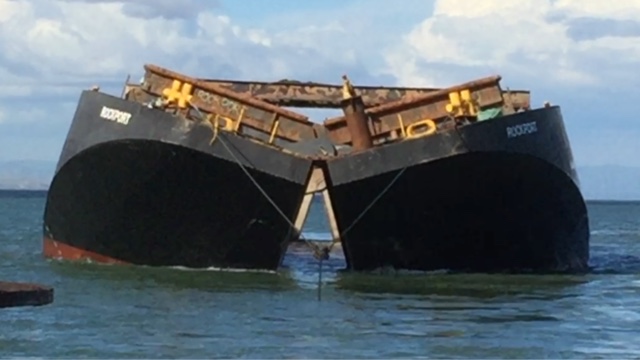
We've been averaging about 2 dumps per day, sometimes more sometimes less depending on whether the dredge has to move out of the channel, for passing ships.

Once 12 rolls around, I get relieved by the other mate, I'll grab some lunch and hit my rack for some sleep, maybe a movie or a book, then do it all over again
6 hours later starting with dinner at 17:00 and a cup of coffee, finishing out my day at midnight.

The weather has been great, the views awesome, and I can't really complain about much. We also have really good internet and phone signal, which helps ease the pain. The 6 and 6 rotation kinda sucks, but considering the facts, it's a pretty good gig. 
When not on watch, I go out on deck and soak up the sun, watch the yachts go by and enjoy the views.

I've been getting a ton of "stick time", landing barges on buoys, moving barges from moorings to docks and back, and have become quite comfortable with the maneuverings, and keeping the barge in the postage stamp sized dump site.

I'll be onboard for another 2 weeks and then home for about a month. Hopefully I'll be back down here for another hitch in December to finish out the job.

Thursday, October 8, 2015

San Francisco Dredgin'

Well, when I got into tugs, it was my goal to find work in San Francisco Bay.  This month, I met my goal at least for the short term.  Our company landed a dredge job near Richmond, so I'm sitting down here for about a month moving dump skows daily.  It's not the most glamorous life, but it's certainly nice being on the Bay and driving around the waterways that I know and love.  I know the San Francisco Bay, having spent quite a few summers down here sailing and anchoring around as a kid as well as sailing with Tradewinds Sailing Club out of Richmond Marina a few years back.  It brings back good memories and the weather has been excellent to say the least.
I'll be down here for a few more weeks, and then rotating out.  The job is supposed to take about 3 months total.  

If you don't know what a dump skow is, check out my video here:

I like to kill the time with photography and photo editing.  Enjoy!

Friday, August 21, 2015

Workboat Academy Recap

I get occasional emails through my blog asking about my experiences with Pacific Maritime Institute (PMI) and the Workboat Academy over the past 2 years of my schooling and if I felt like it was “worth it”.  So, I thought I’d take some time to recap on my overall experiences so that potential students can get a feel for what to expect and hopefully demystify any of the process.

Although PMI has a few different programs for getting people advanced in the industry, I chose the Workboat Academy Mate Program (WBA).  One of the main contributing factors for choosing the WBA program was that at the time, I was unemployed and looking for a new career.  I had sea time from my Navy days, and could have opted for the AB to Mate program, but it is mostly designed for deckhand/AB’s who are already working in the industry and are currently employed, yet looking to advance.  The WBA program is designed as a starting point for those who don’t already work within the industry and PMI will help you find a company to sponsor you for the 2-years of the program, essentially helping you find a job.  Most students in the WBA program, end up being hired as OS’s or Cadets in the early part of the program, and move up as they chip away at their classes and licensing.  After licensing, nearly all companies involved with the program, end up moving the student into a mate position.  The company I work for (Dunlap), was able to get me into a mate position within weeks of obtaining my license.  So, not having a maritime job prior to signing up for PMI, it made sense for me to go the WBA program route and get a job along with the 2-year structure. For those coming out of the military, utilizing the GI bill at PMI is probably your best bet.

The other program of interest at the time, was the AB to Mate program, which as I’ve mentioned, is designed for those who already have sea time and a company.  It’s a shorter timeframe, a little less money and more condensed.

The WBA program spreads out the classes over 2 years, as well as the payments, into 3-5 week-long chunks of learning.  The progression is set so that you learn a little on various topics, then do a few months of sea time with your sponsoring company and theoretically work on your sign-offs for the topics you just learned.  Each student is assigned a TRB (Training Record Book) that you must take with you on your voyages and get signed off from deck officers along the way.  At the end of the 2 years, you submit your TRB along with your license application to prove that you know the material. 

I get a few folks ask about the cost of the program and I get a few people who don’t understand why it costs so much.  The cost of tuition for the WBA program when I attended, was over $32k (has increased since then), which like I mentioned is spread out over 2 years.  You essentially pay for the chunk of classes as you take them.  Now, if you break down each class that needs to be taken for licensing, you’ll see that they aren't cheap, no matter where you go for instruction or how you split it up.  There are many schools out there that offer the same classes and they all range from $500 on up to $2000-$3000 per class x 2-4 various classes per school phase.  The prices add up.  The WBA program throws a few more classes at you than you may or may not need, but they want to provide you with the certifications that are sought after in the industry and that help you become more marketable as a new hire within the maritime industry.  For instance, GMDSS (Global Maritime Distress Safety Service) isn’t required for licensing unless you’re going to be working on a GMDSS ship, however, by having it under your belt, you’ll have a leg up on the competition when it comes down to comparing resumes on the hiring desk.  If you were to skip the program and take all the classes that you need for licensing, you’ll most likely end up paying more ala carte, than you would be lumping them into one nice easily scheduled program.

Within that tuition, you also get a fair amount of simulator time at PMI and a pretty good amount of reference material and tools.  SIM time, in my opinion, is extremely helpful with helping students see the applicability with the material that they are learning.  I’m a hands-on learner, and no matter how much time I spend in the classroom, I won’t begin to understand the content until I begin to apply it in real life, or in this case, a simulated  atmosphere.  Not only was SIM time helpful, but extremely fun and it gave us the opportunity to see how things work on various ships.  It was very realistic, run very professionally and the quality of the equipment was top notch.  PMI’s has invested a great deal of time and money to dial in their simulators.  They have clients coming in from all over the world to spend time in the SIM modules. I particularly liked the Z-drive SIM because of the maneuverability of that particular type of tug platform.

The instruction was always very professional and as with any school, you’re always going to have some instructors that present things better than others.  Over the 2-years, we only had 1 or 2 that didn’t seem to present the material in a “picture perfect” format.  Not because they didn’t know the subject matter, but it had more to do with knowing too much.  PMI hires instructors from all over the U.S. and in some cases might bring in an expert on a topic to teach the class.  That doesn’t alway mean that you’ll get someone who can convey the topic in a fashion that works well for your learning style.  I guess my point, is that we had to tune out some of the extraneous info from the experts to get to the nuts and bolts of what we needed to learn.  Our Stability class was taught by one of the leading experts on Stability in the country, so he would go on for days about various sub-topics, whereas we only needed to know A, B & C, maybe a little D.  Almost every instructor was top notch, professional, friendly and very likeable.   These are all seasoned and licensed professionals, who either still work in the industry, or who potentially are in the process of backing down and deciding to get involved with the teaching process.  Quite a few of the regular instructors are full-time staff at PMI and wonderful people. No complaints from me regarding the quality of the instruction and or instructors. 


So, to sum things up, I was extremely happy with my choice to do the WBA program at PMI.  There aren't many other options for those wanting a 2-year program in the U.S. that lands you a 1600ton Mate license AND a job to boot.  I already had a degree, so a 4-year school like Cal Maritime, Maine Maritime, etc. didn’t appeal to me.  The WBA program was the best approach for me at the time and I’m very happy that I took the step to make the initial call.

I'm always willing to answer questions about the program, so feel free to contact me through the blog.


Saturday, July 18, 2015

North South and North again

Well, I'm once again in Anchorage and about to spend a really long day on the barge doing cargo.  I had flown up here a few weeks ago, hopped on to the Snohomish and took it south to Seattle, then sat in port for a few days before hopping onto the Polar Ranger for another trip to... you guessed it, Anchorage (and beyond).
Polar Ranger
So, it's Saturday the 18th around 01:00 and I'm standing security watch for a few hours before we head over to the barge and start cargo at 06:00.  It will be a long day, especially with only 3 hours of sleep under my belt since yesterday morning. This barge is fairly full, and it's supposed to get most of its contents unloaded and some of it will get back-stowed or re-loaded in a different spot. We were originally going to hit Nome on this trip, but things changed and now we aren't, so some of this cargo intended for Nome has to get pulled and placed in a different spot.
Our barge (the Westward Trader)
The trip north went well.  We popped strait out into the Gulf because the weather was looking good and "supposed" to be south easterly, meaning that the winds would be at our backs as we headed northwest... but not the case.  We had winds on our port side almost the entire time, putting us in the trough and rolling us around a little the entire time.  It wasn't terrible, but it was enough to annoy you after 4-5 days of it.

Once we wrap up our off load and re-load here in Anchorage, it's off to Dutch Harbor, then up to Bethel, Dillingham, Naknek and back to Dutch, or at least that's the plan as of today.  Things change rapidly in this business and the next thing you know, you're on a boat heading somewhere else, doing something entirely different with a completely new crew.  It doesn't always go like that, but it can and has.

I'm settling into my new duties as 2nd Mate pretty well.  The boat driving aspect is easy to do, but there's paperwork and reports that need to get done, so I'm learning.  I'm also still learning more about winch operations and other fun stuff that we get to handle when underway, but for the most part, it's all going great.

The most exciting part of this trip for me, is that my new room, even though it is smaller than the AB's room, has a really long bed.  Being 6'2", this is a big deal.  I'm always cramped on these boats because of my height, but this bed is an awesome 7' long and has nice little shelf at the end for my laptop, or what I call my "entertainment center". No longer do I have to lay diagonally to fit and I have been sleeping wonderfully.

Sleep is a funny thing out here.  When you're underway, you get too much sleep.  I average about 9 hours a day when we're at sea, yet in port we sometimes go 20-30 hours without much rest.  Somehow it all works out.  There's really not much else to do, especially when it's crappy outside and you can't go out on deck.  You eat, sleep, watch a movie, read a book and stand your watches.  Get's a bit boring after a while.  I try to workout, but I hate working out in the engine room, so if the deck is awash, I don't workout.  I have, however, been doing pushups on my night watch.  I'm doing 20 every hour x 8 hours/day.  Occasionally I'll take a day off to rest my boobs, but so far, I've done a crap-load of pushups and seeing good results... I'm already jumping up one cup size.  :-)

Anyhow, I'm babbling and should probably go make some rounds and ensure that the gen sets aren't spewing diesel all over the engine room.  more later.

Tuesday, July 7, 2015

OICNW

It's day 2 underway out of Anchorage and I've stood 3 successful watches as a mate and feeling really good.  In the world of "Coast Guardness", you have a series of assessments and requirements in order to be qualified and licensed as a navigational watch officer, or what they call "Officer In Charge of a Navigational Watch" (OICNW). I obviously have completed all of mine or the wouldn't be sailing as a mate. All of those requirements become a daily part of your life when standing watch.

My 4-hour watch, (2x/day), consists of log keeping, positional chart plotting, course adjustments, navigational arrangements with other vessels via VHF radio, vessel traffic check-in at set checkpoints, chart corrections, various paperwork and daily reports. It's not rocket science, but it does apply everything I've learned over the past 2 years.

There is a certain peace of mind when standing watch in the wheelhouse.  It's hard to explain, but that feeling of you and the sea working together in some sort of weird harmony. I have great respect for the water and feel almost honored to be allowed to drive a boat across it.  I like it.

Anyhow, it's 5am and I feel the need to watch some TV or maybe even a read a book.  I know one thing that I won't be doing on this trip... STUDYING!

Tuesday, June 30, 2015

New career: Day 1

Well, I'm sitting on a plane heading to Anchorage Alaska for my first trip as Mate, and essentially Day 1 of a new career.  

The last 2 years have flown by and it still hasn't hit me that schooling is over and that the licensing process is done with.  I'm excited, nervous and tired (from getting up at 03:30) all in one nice little package but mostly just looking forward to officially starting this new career in the maritime world.

The past 27 months were an essential part of the process, but they were all part of the training and licensing path to get me through to this stage where the career begins.  This what I envisioned about 3 years ago when I decided to get back into the maritime world.  

It won't be easy and I don't expect it to be "fun" as some people might think, but it will be a good solid job, good income and will include something that is core to me, the water.  Don't get me wrong, I always make things fun somehow, but day-to-day life on a 40 year old boat and being away from family for extended periods of time is no joke.  I look forward to having good solid chunks of time at home and a job that allows my family to travel and have fun when those chunks of time arrive.

So, my boss has me flying into Anchorage and joining a crew on the "Snohomish" to bring a barge back down to Seattle.  It'll be a short run, but then I'm apparently staying onboard for yet another run back north, most likely hitting Juneau, Anchorage and maybe one other port.  Details to come...

My blog from this point forward will mostly be focused on the career, the people, the places and the experiences as I move forward and hopefully "up" over time.  My next benchmark is to get my upgrade to Master in a few years and eventually move up to Captain.  

Being a Mate is like being co-pilot #2... You take turns driving the boat with the other Mate and the Captain. My particular watch is from 12-4 morning and night (00:00-0400 and 12:00-16:00).  The Captain does the 8-12's and the Chief Mate stands the 4-8's.  When we are pulling in and out of port, the Captain usually takes the helm or he directs the Chief Mate via radio from the barge. The Cook, AB, and the engineer also stand watches parallel to us so that we always have a watch partner while the rest of the crew sleeps.

So, here we go... wish me luck!

Monday, June 8, 2015

Licensed! Pigs do fly!

I know that I said I was going to post up some progress reports while I was home studying, but the reality is, that when I got home from my 2 weeks of official test prep at PMI, I went into a headspace that I did not know existed.  For 4 weeks, my day consisted of getting up, making coffee, making lunches for the kids and seeing them off to school. After which, I would sit down at the kitchen table and stare at tiny numbers and formulas until the mid afternoon until it was time to pick up my son from school.  I would then come back home, squeeze out another few hours at some point before dinner and bed.  I was pretty religious about this because I knew it needed to get done in order for me to make it through exams.  It hurt, my eyes were fried, my back hurt, I was eating crap and drinking way too much coffee and hadn't worked out in weeks.  A very unhealthy month to say the least.
Our kitchen table for 4 weeks.
I started the official studying process in January with an app called Upgrade U.  I was home for a few weeks, so I would spend about an hour or so a day going through various modules, familiarizing myself with the questions.  I went out to sea in Feb and continued familiarization, but focusing more on Rules of the Road since the passing requirement for that module is 90%.  I got a few weeks off after that first trip and then went back out for a month and tackled all the Murphy books, page by page, trying to learn/memorize as much as I could.

My intention was to finish up that second trip, head to test prep at PMI and then go straight into testing, however, test prep reminded me that I had more work to do and I headed home for "a week or two" to finalize things before committing to exams.  Once I got home and started running practice tests all day long, I soon realized that I still wasn't ready and I needed to keep plugging away until my practice scores were consistently in the passing range.

By then end of "at home" week 4, I was completely burnt out on studying and the learning process was beginning to fade.  I got to the point where I just needed to do something different and decided to book my exam date and see what happens.  I was so fried from staring at Lapware and small numbers for 4 weeks, that I didn't care anymore and I just needed to get up from the kitchen table and either pass or fail something and move on.

I called and booked the exam for June 1st, the day after my 46th birthday. (yes, I know I'm old now).

Well, about a week ago (6/1), I headed down to Oakland and began a 3-day testing process, tackling 2/day, studying all night at a friend's house in S.F. and repeating.  I started with Rules of the Road and Deck General on day 1, passing both no problem! Day 2 was Deck Safety and the Chart plot, again, no problems, actually scoring a 100% on my Chart plot! Finally my 2 toughest modules... Nav General and Nav Problems... on day 3.
"Boo" helping me with some chart plots
So, I came back to my friend's house after day 2 and hit the books in the afternoon/evening for about 8 hours, completely stressing out about the last 2 exams knowing fully that Day 3 was either make it or break it.  I ran Nav Problem after Nav Problem and was still not sure if I was ready.  The next morning, I woke up at 3:57 am and hit the books again until 6am, grabbed my stuff and headed to Oakland where I studied for another hour before walking into the REC for Day 3 chaos.

Nav Gen went ok and it was easier than I had imagined, then came the Nav Problems test.  I struggled with one question because it threw a curveball at me, I skipped it, finished the rest of the easier problems, came back to the problem child, figured it out, turned it in and passed with a 90%!

No repeats, no hiccups!

I about passed out when she told me I passed.  I was so relieved, ecstatic, stoked, lightheaded? etc...  and could not believe that I had somehow managed to pass my exams.  In fact, it still hasn't hit me 5 days later.
Minutes after passing my final exam, outside REC Oakland 
2 years, 83 days after I started the training and licensing process, I'm done and licensed (although still waiting for the official MMC to arrive, which should be in a day or two).

Wow, me... a licensed deck officer?  Still not sinking in.

Now, I'm back home and awaiting the arrival of my MMC before I can head back to work.  My boss said he'll have me on a trip in a few weeks, which is perfect because I can now actually relax and have a some time to chill, go camping, work around the house and spend some quality time with the family before jumping right back on a boat.

I have to say that without the support of my wonderful wife Erin, my awesome kids, all my other family members and friends, I would not have been able to pull this off.  There were times, where I was just tired and wanted to take a side step.  All the travel, studying, back to back trips and being gone... but the end result is well worth it.

All in all, a quick 2 years and everything went smoothly.  It was stressful at times, but completely within reach with a little effort and some passion.  I have a good luck charm that my wife Erin gave me when I started this process in March of 2013.  He is "Voodoo Pirate", designed to ward off bad juju and he accompanied me into the exam room (in my pocket) and I now have good faith in this guy.  He's been with me for the past few years and things have gone quite smoothly ever since.
Voodoo Pirate Lucky Charm
My fortune cookie inspiration that is taped to my laptop.

I'll continue to blog about the life as a mate on Ocean-going tugs and beyond.  This is just the beginning of my career and I'm looking forward to learning more, doing new things and tackling whatever life throws at me.
-cheers!